
Licensed pest control
Ant Control Services
Ant control means killing the colony and its queens with slow baits, and a one-time professional visit costs $200 to $300 on most homes. Carpenter ant and fire ant jobs run higher, $250 to $500, because the tech has to find nests in wood or treat a whole yard. Spraying the trail you see on the counter rarely fixes anything, since the workers you kill are a small slice of the colony. Tell us which ants you have and we’ll connect you with a licensed company near you for a free quote.
- Licensed & insured techs
- Free, no-pressure quotes
- Homes, apartments and businesses

What Do Common House Ants Look Like?
Most ants in your kitchen are tiny, about an eighth of an inch, and dark brown or black. Odorous house ants give off a rotten coconut smell when you crush one. Pavement ants are a touch bigger, with fine parallel grooves on the head, and they leave little piles of sand along slab cracks.
Carpenter ants stand out by size: workers measure a quarter inch to half an inch and come in black or red and black. Fire ant workers vary a lot inside one mound, roughly 1/16 to 3/16 inch, and they’re reddish to dark brown.
Winged ants indoors can look like termite swarmers. Ants have a pinched waist, bent antennae and front wings longer than the back pair.

Signs You Have an Ant Problem in the House
Steady Trails Along Edges
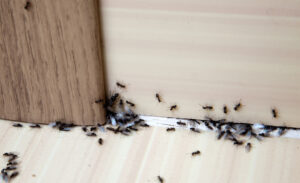
Lines of ants running along baseboards, countertops or window frames to a food or water source, often worst after rain or a dry spell.
Sand Piles by Slab Cracks
Small heaps of fine soil next to cracks in the garage floor, basement slab or driveway point to pavement ants nesting underneath.
Coarse Sawdust Under Wood
Piles of wood shavings mixed with insect parts below a window frame or beam mean carpenter ants are hollowing out damp wood.
Loose Dirt Mounds in the Lawn
Fluffy mounds with no opening on top, often after rain, that boil with stinging ants when you disturb them are fire ants.
Ant Species Found in US Homes
Five ant species account for most of the calls in the states we cover. Each one needs a different bait or method, so naming the species comes first.
| Ant | Where in Our States | What It Means for You |
|---|---|---|
| Odorous house ant | All 10 states | Nests in wall voids and under mulch, trails to sweets. Sugar baits work well on it. |
| Pavement ant | The Northeast and Midwest, plus parts of California | Nests under slabs and sidewalks. Baits placed along cracks handle most cases. |
| Carpenter ant | All 10 states, worst in damp wood up north | Doesn’t eat wood but tunnels through it. The nest has to be found and treated directly. |
| Red imported fire ant | Texas, Florida, Georgia, most of North Carolina and parts of Southern California | Painful stings that leave white pustules. Needs a yard-wide bait plus mound treatment. |
| Argentine ant | Coastal California and the Southeast | Huge colonies with many queens and trails over 350 feet long. Liquid baits beat sprays here. |
How Pros Get Rid of Ants
Ant treatment works by feeding the colony, not by killing the ants on your counter. A pro sets slow-acting baits along the trails, the workers carry the bait home and share it mouth to mouth, and it reaches the queens. UC IPM points out that barrier sprays can make things worse by trapping ants inside and splitting colonies, which is why spraying a trail backfires. Expect fewer ants in 5 to 10 days and full control in a few weeks.
Fire ants get the Texas A&M AgriLife two-step method: broadcast bait over the whole yard, then treat any mound that’s still a problem. Carpenter ants need the nest itself found and dusted or treated.
What Happens on an Ant Job
- Inspection
- The tech follows trails to entry points, checks moisture around windows and sills, and identifies the species from a sample.
- Bait Placement
- Gel or liquid baits go along trails and cracks inside, with granular bait outdoors near nests. Nobody sprays the trails you see.
- Nest or Mound Treatment
- Carpenter ant nests get treated inside the wood or wall void. Fire ant mounds that survive the bait get a drench or granules.
- Follow-up Visit
- A second visit a few weeks later refills baits and checks for new trails. Follow-ups cost $40 to $120 when they aren’t in the quote.
How Much Does Ant Control Cost?
Ant control costs $200 to $300 for a one-time visit on most homes, and the national average is about $250. Species and spread move the price most. Carpenter ants, fire ants across a big lawn and severe infestations land at the top.
Prices come from Angi’s ant exterminator cost guide. Ask each company to name the species and the method in writing, because a bait job and a spray job are not the same work.
| Job | Typical price |
|---|---|
| One-time treatment | $200 to $300 for a typical home |
| Carpenter or fire ant specialty job | $250 to $500 |
| Fire ant two-step method | $500 to $1,000 for bait plus mound work |
| Severe infestation | $800 to $1,400 |
| Quarterly plan | $400 to $500 a year |
| Follow-up visit | $40 to $120 each |
Can You Get Rid of Ants Yourself?
DIY ant control works on small trails of odorous house, pavement or Argentine ants. Liquid borate bait stations, such as Terro, kill colonies when you leave them alone for a week or two and don’t spray near them. For fire ants, a hardware store bag of broadcast bait like Amdro handles step one of the two-step method, and DIY supplies run $30 to $100.
Call a pro for carpenter ants, since the nest hides inside walls and the damp wood behind it needs fixing too. Bring one in for fire ants in a yard where kids or pets play, or any ant problem that comes back after two rounds of baits.
So: a trail of small ants to the sugar bowl, bait it yourself. Carpenter ants or a lawn full of fire ant mounds, get a licensed company.
How to Keep Ants Out of Your Home
- Trim shrubs and tree limbs so nothing touches the siding or roof.
- Wipe counters and store sugar, honey and pet food in sealed containers.
- Fix leaks and replace damp window frames that draw carpenter ants.
- Caulk gaps around pipes, cables and window trim on the outside walls.
- Pull mulch back a few inches and keep firewood off the house.
Ant Control in Your State
The ant species you face depends heavily on your state, especially for fire ants.
How It Works
Tell Us The Problem
Tell us what the ants look like, where the trails run and your ZIP.

Get Matched With A Local Pro
We match you with a licensed ant control company that works your area.
Book Your Treatment
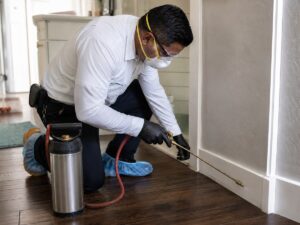
The tech baits or treats the nest, and you book only if the price suits you.
Ant Control FAQs
Got an ant question we skipped? Send it through the form with a close photo of one ant.
Why do ants come back after I spray them?
Spray kills the workers on the trail, but most of the colony and its queens stay safe in the nest. Repellent sprays can also split one colony into several.
Slow baits fix that because workers carry them home. Expect fewer ants in 5 to 10 days.
How can I tell carpenter ant damage from termite damage?
Carpenter ant tunnels are smooth and clean, with coarse sawdust and insect parts piled outside. Termite galleries are rough and packed with soil or droppings.
Carpenter ants don’t eat wood, they nest in it. Treatment for them runs $250 to $500.
What is the two-step method for fire ants?
Texas A&M AgriLife recommends broadcasting fire ant bait over the whole yard, then treating problem mounds with a drench or granules. Spread bait when the grass is dry and no rain is due for 24 to 48 hours.
Bait takes weeks to months to reach 80 to 90 percent control.
How long does ant treatment take to work?
Baits show results in about 5 to 10 days, and full control takes a few weeks. Fire ant bait is slower.
Don’t spray cleaner or insecticide near the bait stations in the meantime, or the ants stop feeding.
Is a quarterly ant plan worth it?
A quarterly plan costs $400 to $500 a year, compared with $200 to $300 for one visit. It pays off in fire ant country or a house that gets ants every spring.
For a one-off trail of sugar ants, a single visit or DIY baits will do.
Get a Free Ant Control Quote
Use the form to tell us which ants you’re seeing and where. A licensed ant company near you sends a price, and you don’t owe anything for asking.
Along with ant work, the companies we match you with handle Termite Control, Roach Extermination and Spider Control, plus every other pest control service we list.